

For Jane Brockmann, Ph.D., a fascination with the natural world began long before she became a distinguished scientist and professor at the University of Florida. It began with a childhood spent observing animals, exploring the outdoors and accompanying her mother on birdwatching adventures.
With her bright smile and sparkling eyes, Jane Brockmann has an engaging presence. Her passion for research and wildlife conservation is contagious, inspiring those around her to learn more about the natural world. Her experiences offer a fascinating story, one that reflects her curiosity, dedication and passion for discovery.
Born in Kentucky and raised in Indianapolis, Brockmann developed an early appreciation for nature. One of her earliest memories is of outings with her mother, an enthusiastic birdwatcher, who would sometimes take a rowboat to observe birds. Brockmann and her brother, Tom Brockmann, a retired anthropologist, remain close and share many fond memories of their family life. The family lived on the White River, across from an unoccupied island, surrounded by woods and wildlife, providing an ideal setting for a young naturalist.
Brockmann’s mother also encouraged her curiosity by giving her books about animal behavior and natural history. Those early experiences helped shape what would become a lifelong passion.
The family moved to Chicago when Brockmann was nine years old, and she attended the University of Chicago Laboratory School from sixth grade through high school. She continued bird watching by joining the Chicago birding club and taking field trips with the Chicago Ornithological Society. By high school, Brockmann already knew what she wanted to do: become a professor and study animal behavior.
An Academic Journey Fueled by Curiosity
Brockmann pursued her interest in science at Tufts University, where she earned a bachelor’s degree in biology in 1967. She chose Tufts in part because of their courses in animal behavior.
Her graduate studies took her to the University of Maryland and eventually the University of Wisconsin–Madison. She earned her master’s degree in 1972 and her Ph.D. in zoology in 1976.
Her early research included studies of fish, birds, insects and the interactions between predators and their prey. A research expedition to Peru, where she studied bird behavior along an elevated gradient, further confirmed that animal behavior was the field she wanted to follow.
She pursued post-doc studies at Oxford University, through a North Atlantic Treaty Organization, or NATO, Fellowship, where she collaborated with Richard Dawkins, D.Phil., renowned evolutionary biologist and author of “The Selfish Gene.”
In 1976, Brockmann joined the University of Florida faculty. The decision was influenced by both professional opportunity and a desire for warmer weather. As she said, “I spent the first 30 years of my life in the cold. I wanted to be warm!” She also found a welcoming group of colleagues who shared her enthusiasm for natural history.
Over the years, her research expanded to include birds, wasps, beetles, damselflies, crickets and eventually one of Florida’s most intriguing coastal creatures: the horseshoe crab.

Following the Horseshoe Crab
Brockmann’s work with horseshoe crabs began as an opportunity to give her undergraduate students meaningful field research experience. She wanted them to learn beyond the classroom and laboratory, so she took them to Seahorse Key, which is on a 165-acre barrier island just southwest of Cedar Key, Florida.
There, she began observing and documenting horseshoe crab nesting behavior. Her research examined where the crabs nested, how they paired for mating, the differences between male and female behavior and the factors influencing their reproductive success.
What began as a teaching opportunity developed into a major, long-term research program. Brockmann and her students collected information about the crabs’ populations, nesting patterns, sizes, sex ratios and reproductive behavior. Her research helped shed light on how these ancient marine animals make decisions about mating and nesting.
Horseshoe crabs are remarkable for reasons that extend well beyond their unusual appearance. Their eggs provide an important food source for migratory shorebirds, particularly during spring migration in the Delaware Bay area. In addition, their distinctive blue blood also has an important medical application. A substance extracted from their blood cells, known as Limulus amebocyte lysate, or LAL, is used to detect bacterial endotoxins in medical products, including injectable drugs and vaccines.
Brockmann has also worked to make this science accessible to younger generations. Through the educational program “Green Eggs and Sand,” she helped develop curriculum and educational opportunities for fifth-grade students and teachers, connecting horseshoe crab biology with conservation and the birds that depend on their eggs.
Her research also revealed serious challenges facing horseshoe crab populations. At some Florida power plants, crabs were being drawn into water intake systems, where many became trapped and died. Brockmann’s work helped document the problem and contributed to efforts to develop protective measures. Her research and collaboration with other scientists and conservation organizations have helped advance the understanding and protection of Florida’s horseshoe crabs.
A Scientist’s Work Continues After Retirement
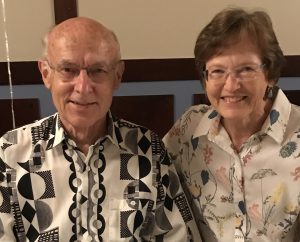
Brockmann retired from the University of Florida in 2011, becoming the first female faculty emerita in the department of biology. But retirement did not mean leaving science behind.
She helped establish the Florida Horseshoe Crab Watch with the National Center for Biological Sciences, Florida Fish and Wildlife Conservation Commission and the University of Florida Institute of Food and Agricultural Sciences, or IFAS, a citizen-science effort that involves surveying, recording and tagging horseshoe crabs. The program has helped gather valuable information about their distribution, population trends and reproductive activity.
Her commitment to research, education and service has earned her numerous honors. Among them are the Animal Behavior Society’s Distinguished Service Award and recognition as a Fellow of the American Association for the Advancement of Science.
In 2025, Brockmann received one of the most prestigious honors of her career when she was elected to the American Academy of Arts and Sciences, one of the nation’s oldest and most distinguished honorary societies. The recognition reflects her significant contributions to animal behavior, zoology and the broader scientific community.
Finding a Home at Oak Hammock
Brockmann has lived at Oak Hammock for the past four years. She chose the community because she already knew many of the residents through friends and her years at the University of Florida and she knew about it’s rich intellectual life.
She and her husband, Tom Rider (now deceased), who was co-owner of Goerings Book Store in Gainesville for many years, had envisioned living at Oak Hammock together. Tom earned a Ph.D. after conducting research in India, shared Brokmann’s intellectual curiosity and love of travel. They were introduced through a mutual friend and, as she recalls, were “two peas in a pod.”
Tom had three children from his previous marriage, Leslie, Peter and Andrew, and Brockmann remains close to all three.
After Tom became ill, Brockmann devoted herself to caring for him. Eventually, Oak Hammock became a good solution for the next chapter in her life.
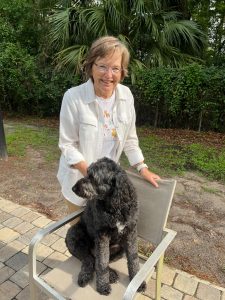
She particularly appreciates the community’s dog-friendly atmosphere. Her dog, Daisy, is a therapy dog who participates in the Read With a Dog program at the library, bringing companionship and encouragement to others.
When asked what people might be surprised to learn about her, Brockmann reflected that her life has been interesting and has not followed a conventional path.
Perhaps that is the best way to understand Brockmann. Her life has been shaped by curiosity, a willingness to explore unfamiliar territory and a deep commitment to learning. From childhood birdwatching adventures to decades of groundbreaking research, she has never lost her fascination with the natural world.
At Oak Hammock, she brings that same spirit of discovery, reminding us that a passion for learning and making a difference has no retirement age.
“I knew of Jane but did not know her at UF. I got to know her after she moved to Oak Hammock and have the privilege of working with her on the ILR Science Curriculum Committee. She is super efficient, organizing the courses and gently prodding us to meet deadlines. Her attention to detail and organizing skills are awesome. Although unassuming Jane’s accomplishments as a Scientist have not gone unnoticed as evidenced by her election to the National Academy.” – Pushpa Kalra, resident
“Working with Jane on the ILR Science Committee is a joy. She leads the group in planning countless courses. But mostly, I enjoy talking with her about science and life on any level. She inspires me. In our conversations, new ideas simply pop out of thin air. And her dog, Daisy, is super special.” – Jane Wood, resident
“I had the good fortune to meet Jane at a new faculty event in the mid 70s when we had both just arrived at UF. She went on to have a very distinguished research career, proved to be an inspirational teacher, and was actively involved in service activities, especially in the area of faculty governance. Not surprisingly, she has been a valuable addition to the Oak Hammock community, whether as a Bee Buddy or for ILR as Chair of the Science Sub-Committee and member of the Board. Add to that the pleasure her faithful sidekick Daisy has brought to Oak Hammock residents.” – Sheila Dickison, resident
“I haven’t worked with Jane however whenever she goes on trips, which is often, I have the privilege of watching her dog Daisy. Jane told me she wants to travel while she is able. Her last trip was to Egypt and before that Madagascar. ” – Richard Grusin, resident
“When we moved to Oak Hammock three years ago, we discovered our friendly, super smart next door neighbors, Jane and Daisy. Jane, of course, is an esteemed scientist, but what we have loved seeing is the scope of her response to animals. She has helped us see them as she does: unique and worthy of attention and respect. I’ll never forget hearing her apologize under her breath to a crab as she tagged its shell: “Sorry Sweetheart”” – Mary Newell, resident