

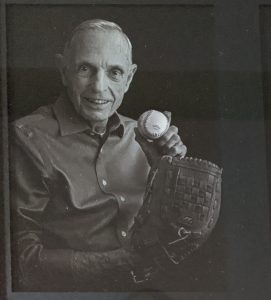
Charles F. “Chuck” Sidman, PhD, is a retired university professor of history, former senior academic administrator, lifelong devotee of baseball and creator of the iconic simulation game Ball Park Baseball. His life reflects a rare and enduring blend of scholarship, leadership, family devotion and creative innovation.
Now 94, Sidman remains tall, distinguished and unmistakably professorial. His eyes still sparkle when he speaks about his scholarship, his life’s work and the game he first conceived in 1957 — a project that would grow into a multi-generational enterprise.
Growing Up
Born in 1931 in Cleveland, Ohio, Sidman grew up in a family frequently on the move. His father’s corporate career required regular relocations, therefore adaptability became a defining trait early in his life.
In 1947, shortly after his sixteenth birthday, Sidman traveled to Chicago with his teammates to celebrate an Iowa statewide American Legion baseball championship. When it was time to return to Des Moines, he informed his coach that his father had been transferred back to Cleveland, and that he would be traveling alone by train.
At LaSalle Street Station, he purchased a ticket and boarded for the nearly eight-hour journey. During that solitary ride, he made a pivotal decision: academics would become the center of his life. Athletics would remain important, but secondary. It was a quiet yet defining moment of self-determination.
Academic Career
Sidman earned his undergraduate degree in history from John Carroll University, while also receiving a commission as an ROTC officer in the United States Army. He served two years in Japan and South Korea before returning to complete his master’s degree in 1956.
He then entered the doctoral program at the University of Wisconsin–Madison, earning his PhD in January 1960.
His first faculty appointment was at the University of Kansas, where he rose from instructor to full professor and ultimately served as chair of the History Department.
In 1978, he was recruited to the University of Florida as dean of the College of Liberal Arts and Sciences and University College. One of his earliest responsibilities was to merge the two colleges into a single academic unit — a complex undertaking he successfully completed. Under his leadership, the faculty expanded to between 650 and 700 regular members, reflecting a period of significant institutional growth.
Family Life

Sidman met Margaret Anne “Margi” Clarke on a blind date in late 1956. They married six months later, in July 1957, just before departing for Germany, where Sidman had received a Fulbright Scholarship to the University of Tübingen.
When asked why she finally said “yes” after declining so many other suitors, Margi smiled and explained that she wanted to go to Europe “in the worst way” — and did.
Over the next seven years, the Sidmans adopted five children through Catholic Charities in Kansas City. Their family life centered on five guiding pillars: faith, education, hard work, honesty and travel. It was not always easy, but it was rich in purpose and shared experience.
Now married nearly seven decades, the Sidmans have lived for more than 21 years at Oak Hammock at the University of Florida. They remain active contributors to community life, helping establish initiatives such as the OHICAN! scholarship program, Bosom Buddies and participating in the Institute for Learning in Retirement lecture series.
They were interviewed by the Samuel Proctor Oral History Program at the University of Florida on February 25, 2025. To learn about their history in more detail, see the attached link.
What would you recommend for people considering Oak Hammock?
When asked what they would recommend to those considering a life plan community, also known as a continuing care retirement community, or CCRC, Margi answered without hesitation: they never considered anywhere else.
“This is where our friends were,” she explained.
They believe Oak Hammock attracts intellectually curious, engaged individuals and offers abundant opportunities for activity, friendship and purpose.
Their advice to others is simple:
“Do it now, while you can still enjoy all the community has to offer.”
Ball Park Baseball
The origins of Ball Park Baseball trace back to Sidman’s Fulbright year in Germany (1957–58). Concerned that his intense academic focus might affect his health, Margi encouraged him to find a relaxing diversion.
From that suggestion emerged the early framework of a game.
The project rekindled Sidman’s lifelong love of baseball and drew upon lessons his father had taught him about the sport’s intricate subtleties. What began as a creative outlet gradually evolved — without any initial commercial ambition — into something far more substantial.
While completing his doctorate in Madison, Wisconsin, Sidman continued refining the game. In 1959, an early tournament featuring handmade player cards was staged during a family gathering. The concept had taken hold.
From the outset, three guiding principles shaped the design:
- Accuracy — Player statistics must reflect real-world performance.
- Realism — Gameplay should immerse managers in the ballpark atmosphere.
- Playability — The rhythm and flow should mirror actual baseball.
At the University of Kansas, the game flourished. In January 1961, Sidman organized a formal faculty league using major league teams — a league that has continued uninterrupted for more than six decades and is now in its fourth generation of managers.
Among its participants was Bill James, widely regarded as the foremost writer and researcher in baseball analytics, who has credited Ball Park Baseball with shaping his analytical approach to the game.
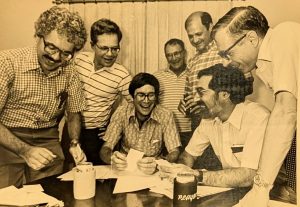
As interest expanded to students, the Sidmans opened a restaurant called Ball Park Baseball, where classic ballpark fare was served and the game could be played onsite. The concept proved popular. After graduation, many students requested teams of their own, leading to the game’s first commercial release.
Following Sidman’s move to Florida, the game’s growth slowed temporarily. After his retirement in 1996, it entered a new phase. With the rise of computing, Sidman partnered with a University of Florida chemistry doctoral student to translate the game’s mathematical formulas into computer algorithms — more than 25,000 lines of code — bringing the system into the digital era.
To ensure long-term sustainability independent of his personal involvement, Sidman temporarily withdrew the game from the market while building a fully autonomous structure.
After a six-year hiatus, Ball Park Baseball has relaunched as Version 3, offering a fully digitized experience via downloadable PDFs. The relaunch features redesigned cards, enhanced statistical precision, expanded playbook outcomes and comprehensive historical coverage.
The game now includes:
- Nearly 3,000 Major League teams (1893–present)
- 135 ballparks
- 132 years of baseball history
- Detailed player ratings, park charts, strategy guides and score sheets
A new leadership team oversees operations: Rick Schostek (COO), Katie Sidman (CFO), and Sullivan Beck (CTO). At 94, Charles Sidman remains actively involved in the game he created more than six decades ago.
To learn more and purchase the game, click on this link: ballparkbaseballgame.com
A Lasting Philosophy
“In life,” Sidman often observes, “failure is not the problem. The real problem is never trying to accomplish something worthwhile.”
That philosophy echoes through the reflections of those closest to him.
“As young adults, our parents had an innate interest in travel that supported their lifelong quest for adventure, learning and cultural immersion — not as tourists, but as residents.” — Charles Sidman, son
“Ball Park Baseball gave my dad a creative outlet that combined his passion for the game with his competitive spirit.” — Katie Sidman, daughter and CFO
“One Ball Park league has been playing weekly for more than 65 years. That’s what I call avid fans.” — Rick Schostek, nephew and COO