


How do you encapsulate the life of someone who has achieved a lot and lived adventures most people can only dream about? Mary Kilgour’s life has been one of unparalleled exploration and global involvement. Reading her first book, “Creative Recollection of a Foreign Service Life,” readers are transported to a world of heroes—people who strive to make a difference globally. Mary points out that the stories are fictional, but all have a kernel of truth in them.
When speaking with Kilgour, she calmly stated her life experiences as though she’d had a regular job just like everyone else. We met in my office in between her swimming and pottery class schedule. She was warm and friendly, but it quickly became apparent I needed a copy of her Curriculum Vitae, or CV, to comprehend the complex details of her life’s work.
It is hard to imagine her traveling along a pothole-ridden road in an old, rickety bus headed from her village to a nearby city in the Philippines, surrounded by villagers and two squealing pigs. By sheer fortune, the bus broke down and she found another way to travel. The next day, that same bus plunged off the side of a cliff!
Or consider the time while she was serving as Mission Director with the United States Agency for International Development (USAID) in Dhaka, Bangladesh, she and her team had to assess and aid the recovery efforts following the devastation of Marion, a Category 5 cyclone that claimed over one hundred thousand lives. There, Kilgour worked tirelessly in collaboration with the local government, other donors and the U.S. military to provide essential humanitarian disaster relief to survivors.
Benjamin Franklin once said, “Out of adversity comes opportunity,” and Kilgour’s life exemplifies this truth. Through her work with the Peace Corps and USAID, her contributions
have advanced poverty alleviation efforts, a deep partnership with many countries and enhanced the effectiveness of U.S.-assisted development programs worldwide.
Before her work in foreign service Kilgour faced tragedies and challenges in her own life. In her second book, a memoir titled “Me, May, Mary,” we learn of the difficulties Kilgour faced growing up. Orphaned at 14 after a childhood overshadowed by her parents’ alcoholism and poverty, she spent her teen years in a girls’ home run by Catholic nuns. These early obstacles in Kilgour’s life are the foundation of her resilience in life. Kilgour reveals that the Spanish word sobrevivir, which means to survive, is not just a word, but a guiding principle for her life.
A voracious reader since early childhood, Kilgour’s academic path reflects her determination and thirst for knowledge. She earned her undergraduate and master’s degrees in political science from the University of Connecticut. She later completed a master’s in public administration and a Ph.D. in political economy and government from Harvard. At the end of her career, while assigned as a professor at the National War College, she received a master’s degree in national security studies from that institution.

When Kilgour arrived in Washington, D.C. in the mid-1960s, the atmosphere was not welcoming to women seeking senior positions in government. Yet, with her years of Peace Corps experience and strong academic background, and successive assignments overseas and in Washington over time came to realize she was as qualified as her male peers and capable of making her mark on international development.
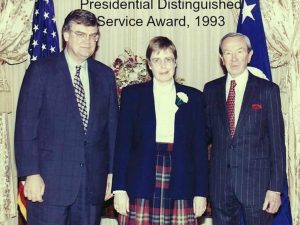
Kilgour’s career includes numerous publications and prestigious awards. When asked which were most meaningful, she said, “The highest award I received while with USAID was the Presidential Distinguished Service Award around the time I retired. More impactful, however, was the group award the American Mission in Bangladesh received from the U.S. Marine Corps for our response to the 1991 cyclone that killed 139,000 people in six hours. Another significant recognition was the group Magsaysay Award given to all Peace Corps Volunteers serving in Asia in 1963. We joked that our share of the monetary award would have been about $1.50 each.”
Recently Kilgour shared details about some of her life experiences:
Why did you choose to begin with the Peace Corps?
I didn’t think of it as the start of a career. It was more a response to John F. Kennedy’s call: “Ask not what your country can do for you—ask what you can do for your country.” It was a time of idealism, and I was a political science major. The Peace Corps appealed to me on altruistic grounds, and it provided a living allowance, which I needed, being an orphan. Back then, I wasn’t thinking in terms of a career and most women didn’t. I knew I wanted to make a difference. I also knew I wanted to see the world, as my brother, Jack, had done when he was in the Navy. I wanted adventure, excitement and the opportunity to do good.
What do you feel was most important about your various positions?
I always did my best, which often meant working unpaid overtime to meet my standards. In hindsight, I realized that in government, you work eight hours a day to get paid, but you work beyond that to advance. The leadership positions I held allowed me to contribute to sustainable practices and an enduring legacy for many global causes.
How do you view the world situation now compared to when you were 19?
It’s much worse. The Cold War, with all its tensions, had a certain stability. Now, the world is more chaotic, with more terrorism, dangerous non-state actors and power-seeking authoritarian actors. Ironically, most countries are wealthier now compared to the period of my career. My Peace Corps area in the Philippines now has electricity, running water and some industry, probably even call centers. But corruption, the enrichment of a few at the expense of many, and the rise of fundamentalism and drugs persist. My view of the world has become more sophisticated and less idealistic.
What has been your favorite destination?
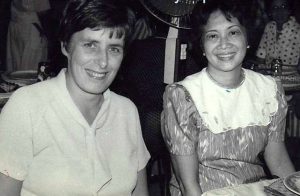
Returning to the Philippines, where I had been with the Peace Corps, was especially meaningful. Even after decades, the friendships I formed remained deep. When I returned in the 1980s, I reconnected with many I knew from the 1960s, which was deeply rewarding. My position in Manila as deputy director of the USAID mission meant I engaged with everyone from senior officials to illiterate villagers, creating an exceptionally broad and fulfilling experience.
Why did you decide to move to Florida?

After retiring from a 29-year career at USAID, I was tired of cold weather and decided Florida would be a good place to live. I was attracted to Gainesville because of the university, the trees and temperatures that were 20 degrees warmer than Washington, D.C. I taught at UF as an adjunct for a couple of years, started some consulting, overseas and with USAID, and then started writing and volunteering in programs such as Habitat for Humanity and the Guardian ad Litem program. After 11 years in Gainesville, feeling fully retired and having dealt with the problems of an uncle who had no children, I moved from my home to Oak Hammock, just before my 67th birthday.
What do you like about Oak Hammock and what would you recommend for others?
I enjoy the friendliness and social atmosphere. I served on the residents’ council for eight years and participate in various committees. I also swim every other day, which is very important to me. It’s a comfortable, fulfilling lifestyle and I appreciate the idea of aging gracefully while maintaining a sense of purpose. I also continue my engagements in the community by volunteering for my church and being an active participant in the pottery studio at the University’s student union. For anyone considering a place like Oak Hammock, I’d recommend touring the facilities, seeing what they offer, and talking to the residents to get a true feel for the community.